
The push for circular economy in plastics manufacturing is accelerating. Governments and brands are demanding higher recycled content in products, with some markets requiring over 25% post-consumer recycled material. But molding with high-percentage recycled content presents unique challenges. Recycled materials behave differently than virgin resins — they flow differently, shrink differently, and have less consistent mechanical properties.
At ISM, we design recycled plastic molds specifically adapted for high-percentage recycled material molding. Here is how we address the unique demands of processing recycled materials.
1. How Recycled Materials Differ from Virgin Resins
During recycling, polymer chains experience degradation. This fundamentally changes material properties that affect mold design and processing .
| Property Change | Virgin Material | Recycled Material | Impact on Molding |
|---|---|---|---|
| Melt flow rate | Base value | Higher (chain scission) | Faster filling, higher shrinkage risk |
| Crystallization rate | Standard | Faster (lower molecular weight) | Earlier solidification, potential short shots |
| Mechanical strength | Baseline | Reduced (chain degradation) | More susceptible to stress cracks |
| Shrinkage rate | Predictable | Variable (by 20-30%) | Dimensional consistency challenges |
| Moisture content | Low | Higher (absorbed contaminants) | Surface defects, degradation |
Key insight: Mold designs optimized for virgin resins often fail with high-recycled content. Every aspect — runners, gates, vents, cooling — may need adjustment .
2. ISM's Mold Design Adaptations for Recycled Materials
Adaptation 1: Gate and Runner System Adjustments
Recycled materials have higher flowability due to molecular chain degradation . This affects gate sizing and runner balancing.
| Gate/Runner Feature | Standard Design | ISM Recycled Material Design |
|---|---|---|
| Gate diameter | Standard sizing | Smaller (to account for higher flow) |
| Runner cross-section | Circular or trapezoidal | Optimized to reduce dead zones |
| Gate type | Standard edge or submarine | Modified for faster filling |
| Flow balance | Standard | Tighter balance (recycled material variation amplifies imbalance) |
ISM practice: Use computer-aided engineering (CAE) simulation to verify gate and runner performance specifically with the recycled material's flow characteristics .
Adaptation 2: Enhanced Venting Design
Recycled materials contain more contaminants and volatiles from prior processing, which generate more gas during injection. This requires more aggressive venting .
| Venting Feature | Standard Mold | ISM Recycled Material Mold |
|---|---|---|
| Vent count | Standard | Increased by 30-50% |
| Vent depth | 0.02-0.03mm | Deeper (0.03-0.05mm) for contaminated materials |
| Vent location | Last fill points | Additional at predicted gas trap locations |
| Relief channels | Basic | Larger, more frequent |
Impact: Improved venting prevents burn marks, short shots, and surface defects common with recycled materials.
Adaptation 3: Shrinkage Compensation Strategy
Recycled materials have variable and often lower shrinkage than virgin materials, but with greater batch-to-batch variation .
| Shrinkage Parameter | Standard | ISM Recycled Material Approach |
|---|---|---|
| Shrinkage assumption | Fixed value | Range-based (allow for variation) |
| Compensation method | Fixed cavity size | Adjustable inserts or conservative sizing |
| Tolerances | Standard | Wider tolerance allowance |
| Process adjustment | Minimal | Process parameters compensate for material variation |
ISM practice: ISM builds molds with slightly more conservative shrinkage compensation and recommends process adjustment rather than precision cavity sizing to account for batch-to-batch variation .
Adaptation 4: Cooling System Optimization
Recycled materials have different thermal properties. Their reduced molecular weight affects crystallization behavior and heat transfer .
| Cooling Feature | Standard | ISM Recycled Material Design |
|---|---|---|
| Cooling rate assumptions | Based on virgin material | Adjusted for recycled material behavior |
| Cooling channel design | Standard uniform | Enhanced for faster crystallization of recycled materials |
| Zone control | Standard zones | More precise zones (recycled materials are more temperature sensitive) |
Impact: Proper cooling prevents warpage and dimensional drift common with recycled materials.
Adaptation 5: Ejection System Reinforcement
Recycled materials have reduced mechanical strength . Ejection systems must be gentler to prevent part cracking or deformation during demolding.
| Ejection Feature | Standard | ISM Recycled Material Design |
|---|---|---|
| Ejector pin count | Standard | Increased (more pins distribute force) |
| Pin diameter | Standard | Larger diameter pins |
| Ejection speed | Standard | Slower, controlled ejection |
| Air assist | Optional | More frequently used |
Impact: Gentle ejection prevents stress cracking of parts made from weaker recycled materials.
3. Advanced Solutions for High-Percentage Recycled Materials
Solution 1: Co-Injection (Sandwich) Molding
For high-recycled-content requirements (30% or more), ISM offers co-injection molding support . This process encapsulates a recycled core with a virgin material skin. The appearance, surface quality, and structural performance of a virgin material product are maintained, while high recycled content is achieved (over 30% demonstrated in commercial applications) . It also allows core-side injection points to be completely hidden by the skin layer .
Solution 2: Simulation-Driven Validation
ISM uses CAE simulation to model recycled material behavior, verifying mold design corrections achieve expected results . Simulation also predicts potential defects and optimizes process parameters for recycled materials.
Solution 3: Impurity and Moisture Management
Recycled materials contain more impurities and moisture. ISM molds incorporate larger, more effective cold slug wells, more generous venting for volatile removal, and moisture-reduction design features.
4. Process Parameter Considerations
Even with proper mold design, process adjustments are critical for recycled materials.
5. Case Study: High-Percentage Recycled Tote Box
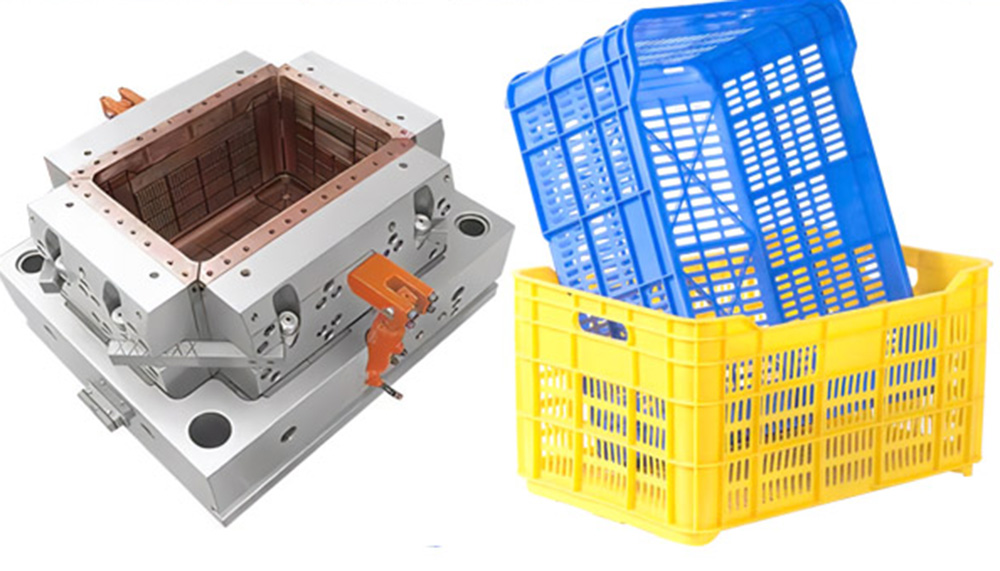
Challenge: A logistics customer needed to produce 600x400mm tote boxes using 40% post-industrial recycled HDPE. Target was identical dimensional stability and appearance to virgin material production.
ISM solution:
Gate diameter was reduced by 15% to account for higher flow.
Vent depth was increased from 0.025mm to 0.040mm.
Ejector pin count increased from 8 to 12 pins (larger diameter).
Cooling channels redesigned with zone temperature control.
Process validation: injection speed increased by 10%, melt temperature reduced by 8°C.
Simulation performed with recycled material flow data.
Results:
| Metric | Virgin HDPE | 40% Recycled HDPE | Pass/Fail |
|---|---|---|---|
| Part weight variation | ±1.2% | ±1.5% | Pass |
| Dimensional tolerance | ±0.5mm | ±0.6mm | Pass (within spec) |
| Impact strength | 100% | 85% | Acceptable |
| Warpage | 1.2mm | 1.4mm | Pass |
| Surface quality | Good | Good | Pass |
Customer outcome: The customer successfully transitioned to 40% recycled content with no production interruptions and no product quality complaints.
6. Common Mistakes in Recycled Material Mold Design
7. When to Use a Dedicated Recycled Material Mold
Consider a dedicated recycled material mold if:
Recycled content will exceed 25% of production volume
Material source will vary (post-industrial, post-consumer, mixed streams)
Product quality requirements are strict (dimensional, appearance, mechanical)
Production volume is high enough to justify dedicated tooling
If recycled content is occasional or below 15%, modifications to existing molds plus process adjustments may be sufficient.
8. Conclusion
Molding with high-percentage recycled materials is not the same as processing virgin resins. Mold design must adapt: gate and runner systems for higher flow, enhanced venting for contaminants, flexible shrinkage compensation, optimized cooling, and reinforced ejection systems.
At ISM, we design recycled plastic molds adapted for high-percentage recycled material molding. Whether you're processing post-industrial scrap or post-consumer recycled resins, we can optimize your mold for sustainable production.
Contact ISM today to discuss your recycled material mold project. We will provide a material analysis and mold design recommendations for your specific recycled feedstock.