Case Study: How a Logistics Company Reduced Crate Weight by 12% Without Sacrificing Load Strength
Executive Summary
In high-frequency logistics and cold chain distribution systems, the weight of plastic transport crates directly influences fleet fuel efficiency, manual handling fatigue, and overall shipping expenditures. However, standard light-weighting initiatives often lead to premature mechanical failure, structural cracking, and buckling under stacked static loads.
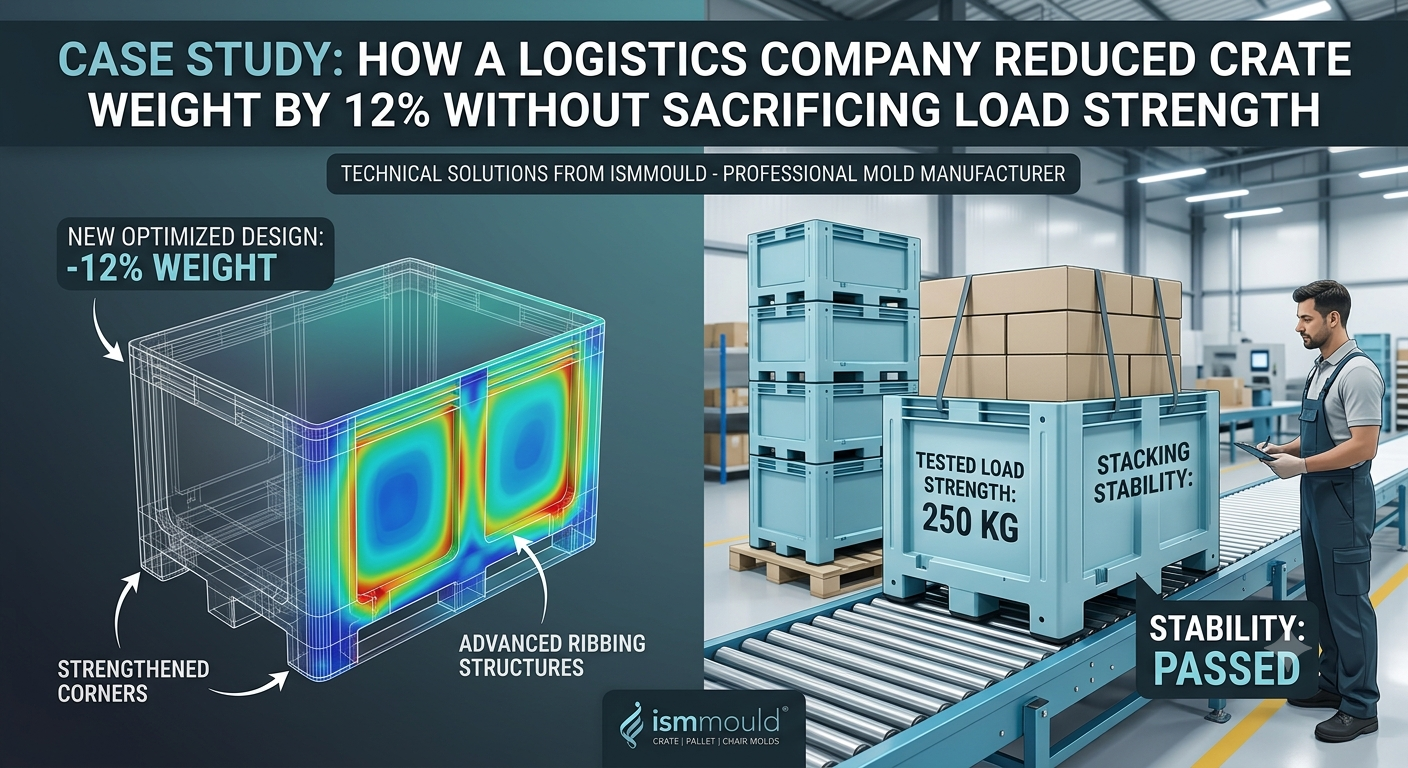
This technical case study documents how ISMMOULD partnered with a leading multinational third-party logistics (3PL) provider to engineer a next-generation stackable transport crate. By implementing advanced moldflow analysis, proprietary rib structural design, and precision hot-runner thermal balancing, we reduced overall container weight by 12% while strictly maintaining—and in localized areas, increasing—ultimate stacking and drop-test load strengths.
1. The Engineering Challenge: Balancing Part Weight and Structural Load Capacity
Our client was utilizing a heavy-duty, 35-liter HDPE stackable crate for grocery logistics, with an average empty container weight of 2.15 kg. With millions of crates in rotation, saving even 200 grams per unit would translate into significant transport fuel savings and reduced plastic resin material cost.
The primary engineering challenge was to bypass the traditional compromise of injection molding: thinning the wall profiles usually decreases structural stiffness. The new crate design had to pass strict corporate quality standards:
- Static Load Capacity: Withstand a continuous vertical stacking compression force of 350 kg at 40°C for 48 hours without collapsing or shifting.
- Dynamic Drop Strength: Survive a 1.5-meter vertical diagonal corner drop onto concrete while fully loaded with 15 kg of payload.
- Cycle Time Efficiency: Maintain or reduce the injection cycle time (target: < 45 seconds) to ensure the client’s manufacturing capacity was not compromised.
2. Technical Interventions: How ISMMOULD Re-Engineered the Tooling & Part Physics
Our engineering team analyzed the existing mold layout and executed a three-step intervention utilizing specialized mold designs developed for industrial crates, pallets, and furniture products:
A. Finite Element Analysis (FEA) and Wall-Rib Optimization
Instead of executing uniform wall thickness reduction, ISMMOULD implemented Variable Wall-Thickness Profiling (VWTP). We reduced the non-structural face wall thicknesses from 2.5 mm to 2.1 mm (a 16% reduction), while keeping critical load-bearing vertical corners at 3.0 mm. To support the load transfer during stack pressure, we designed a customized cross-rib grid along the bottom plate and key corner pillars. The rib base thickness was set at 60% of the adjoining wall thickness to completely eliminate external sink marks while ensuring perfect structural rigidity.
B. Advanced Hot Runner and Gating Strategy
Thin-walled molds require high injection speeds and balanced melt flow paths to prevent material hesitation and cold weld lines (which act as physical failure points during drops). We utilized a 4-drop open-gate hot runner system with integrated sequential pneumatic valve gates. This ensured even, rapid volumetric filling of the high-density polyethylene (HDPE) polymer without excessive shear heating, keeping mechanical physical attributes uniform throughout the crate.
C. Conformal Cooling Design with Beryllium Copper Inserts
Thinning the plastic parts can sometimes cause cooling warping due to uneven heat retention. ISMMOULD deployed double-loop spiral cooling channels mapped closely to the shape of the core. To maximize thermal transfer, we integrated premium Beryllium Copper (BeCu) blocks at the core tips and ejector sleeve zones, where plastic heat accumulates. This resulted in a uniform heat transfer rate and shortened the cooling cycle by 4.5 seconds, saving production energy and raising production capacity.
3. Empirical Results: Laboratory & Field Testing Comparison
Before releasing the finalized multi-cavity industrial tooling, ISMMOULD conducted rigorous structural compression testing on pre-production samples. Below are the comparative performance values:
| Engineering Parameter | Baseline Legacy Crate | Optimized ISMMOULD Crate | Net Operational Advantage |
|---|---|---|---|
| Empty Crate Weight | 2.15 kg | 1.89 kg | 12.09% Weight Reduction (Direct resin cost saved) |
| Max Stacking Load Limit | 360 kg | 372 kg | +3.3% Strength Increase due to optimized rib geometry |
| Injection Cycle Time | 42 seconds | 37.5 seconds | 10.7% Productivity Boost (Saves 4.5s cooling time) |
| Drop Test Success Rate | 96.5% survival rate | 100.0% survival rate | Eliminated stress points through sequential hot-runner gating |
Conclusion: High-Yield Tooling is the Key to Lightweighting
This case study proves that material savings do not require compromising physical durability. Through the integration of precise mold engineering, variable wall topology, and high-conductive thermal cooling layout, ISMMOULD helped our logistics client secure millions in transport fuel savings and material cost reductions, while expanding their total hourly production yield.
As an established global manufacturer of plastic crate molds, pallet molds , and plastic chair molds , ISMMOULD specializes in transforming manufacturing challenges into high-performance, cost-effective tooling assets. Contact our design center today to receive a detailed engineering consult and ROI calculation for your production fleet.