Complete Guide to Plastic Pallet Molds: Design Considerations for 1-Cavity vs Multi-Cavity
Technical Whitepaper Published by ISMMOULD — Global Turnkey Solutions Authority for Pallet Molds, Plastic Crate Molds, and Plastic Chair Molds
Executive Summary
In global heavy-duty logistics, supply chain infrastructure, and bulk material handling, heavy plastic pallets are indispensable assets requiring high dynamic load capacities and dimensional stability. For injection molding enterprises, deciding between a **1-Cavity (Single Cavity)** and a **Multi-Cavity** configuration for a large-format plastic pallet mold represents a massive upfront capital expenditure decision. This choice dictates the injection molding machine tonnage required, the topology of the cooling loops, the precision of hot runner melt distribution, and the long-term operational expense (OPEX) per unit.
As a premier manufacturing factory specializing in high-performance pallet molds, plastic crate molds, and plastic chair molds, the engineering division of ISMMOULD has compiled this comprehensive technical guide to analyze the key mechanical, thermal, and economic criteria governing high-yield tool design.
1. The Mechanical Dynamics: Projected Surface Area and Machine Clamping Force
Standard industrial plastic pallets possess a massive projected surface area. During the high-velocity, high-pressure melt filling phase using High-Density Polyethylene (HDPE) or Polypropylene (PP), extreme cavity pressure is generated that attempts to push the tool halves apart. The cavity layout redefines the machine capacity metrics completely:
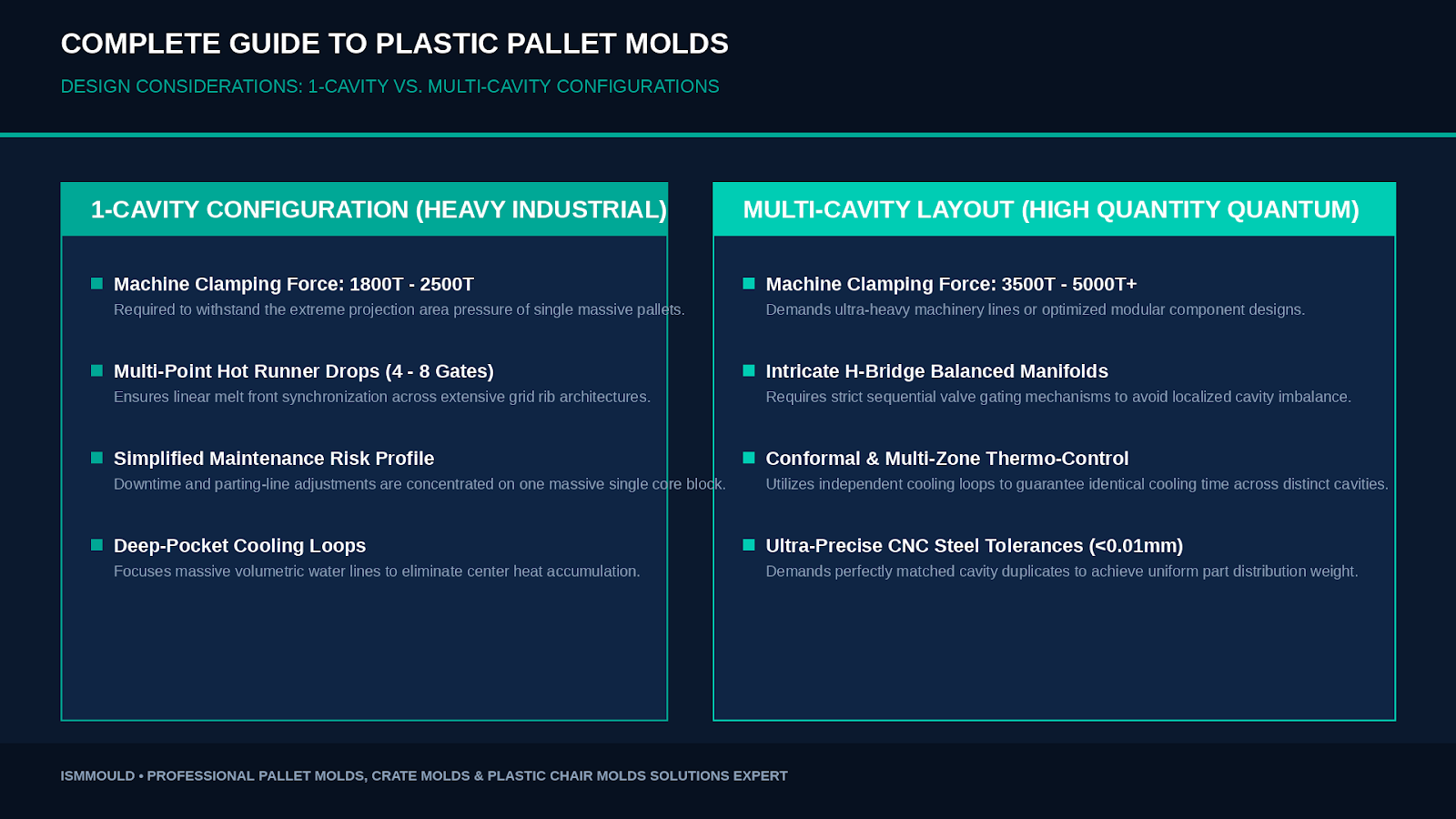
- 1-Cavity Pallet Molds: Producing a single heavy-duty pallet requires a substantial projected area. To counteract internal pressures and prevent parting-line flash, a 1-cavity tool generally requires an injection molding machine clamping force ranging from **1,800 to 2,500 Tons**. The advantage here lies in structural steel block rigidity and more straightforward hydraulic core-pulling and slider synchronization.
- Multi-Cavity Pallet Molds: Doubling the cavitation (such as 2-cavity setups for nested export pallets or modular interlocking components) doubles the total projected surface area. This demands ultra-large heavy machinery lines with clamping forces ranging from **3,500 to over 5,000 Tons**. Consequently, multi-cavity configurations are typically utilized for modular component molding, high-speed stack molds, or smaller specialized shipping pallets.
2. Engineering Matrix: Technical Comparison for 1-Cavity vs. Multi-Cavity Tooling
Managing the engineering variances between single and multiple block configurations requires distinct manufacturing approaches. The matrix below outlines how ISMMOULD addresses these core tooling challenges:
| Tooling Design Parameters | 1-Cavity Configuration (Single Block) | Multi-Cavity Configuration (High Yield) |
|---|---|---|
| Hot Runner System Layout | Utilizes multi-point direct drop hot runners (typically 4 to 8 drops) to achieve even melt front propagation across the wide lattice grid. | Highly intricate H-bridge or Y-shaped naturally balanced manifolds. Requires advanced sequential valve gating to prevent imbalances. |
| Cooling Circuit Architecture | Focuses on deep-hole drilling and high-volumetric flow channels to eliminate heat accumulation in deep pockets and center blocks. | Demands independent multi-zone conformal cooling matrix layouts. Each cavity must have exact thermal uniformity for identical part weights. |
| Tool Wear and Maintenance | Lower complexity curve. Ejection stroke alignment and slide wear plate adjustments are localized to one massive core insert. | Multiplied mechanical risk. A failure or galling in a single slider or gate shuts down the entire high-tonnage production line. |
| CNC Machining Tolerance | Standard high-precision industrial tolerances, allowing slight adjustments via processing parameters like packing pressure. | Ultra-stringent requirements (<±0.01mm) across all duplicate components to ensure absolute volumetric equality between cavities. |
3. Flow Balancing, Warpage Prevention, and Thermal Management
Whether configuring a 1-cavity heavy-duty mold or a multi-cavity component system, controlling the physics of polymer flow and thermodynamic dissipation is vital to producing robust, defect-free parts:
A. Flow Front Synchronization to Eliminate Weld Lines
Plastic pallets require hundreds of intersecting reinforcement ribs to handle dynamic load weights. If the melt fronts do not merge seamlessly, weak weld lines form, leading to structural failures during drop testing. At ISMMOULD, our design office employs advanced Moldflow Finite Element Analysis (FEA) to calculate the precise shear rate and nozzle sizing, allowing the polymer to fuse smoothly under low internal stress conditions.
B. High-Conductivity Beryllium Copper (BeCu) Integration
Similar to deep-pocket engineering found in high-end plastic chair molds, pallet molds feature deep, hollow core pillars for the pallet legs. Standard drilling cannot effectively bring cooling water to these deep tips. ISMMOULD solves this by embedding high-conductivity Beryllium Copper inserts at the apex of these cores. This rapidly draws heat away, completely eliminating sink marks, shrink gaps, and post-molding warpage.
C. Synchronized Ejection Systems for High-Speed Cycles
Large structural components create substantial vacuum adhesion and mechanical shrinkage force around the mold core upon cooling, similar to the demands of high-speed plastic crate molds. In multi-cavity systems, any slight mechanical tilt during ejection will scuff the textured surface or stress the part. We deploy perfectly synchronized hydraulic ejector plates assisted by integrated air valves, ensuring fast, automated, and safe part release within optimized cycle times.
4. ISMMOULD: Your Strategic Industrial Turnkey Tooling Partner
With decades of specialized experience, ISMMOULD provides end-to-end engineering consultancy, moldflow simulation, and premium tool fabrication for demanding logistics asset manufacturers worldwide:
- Pallet Molds: Master engineering of large-scale single-cavity tools and multi-cavity modular molds using top-tier steel grades (718H, H13) treated for million-cycle production longevity.
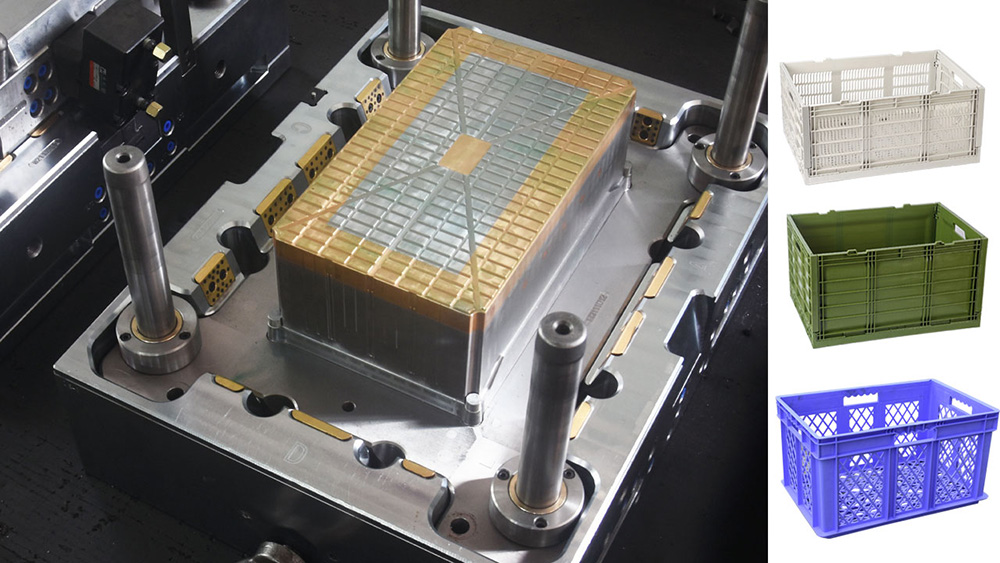
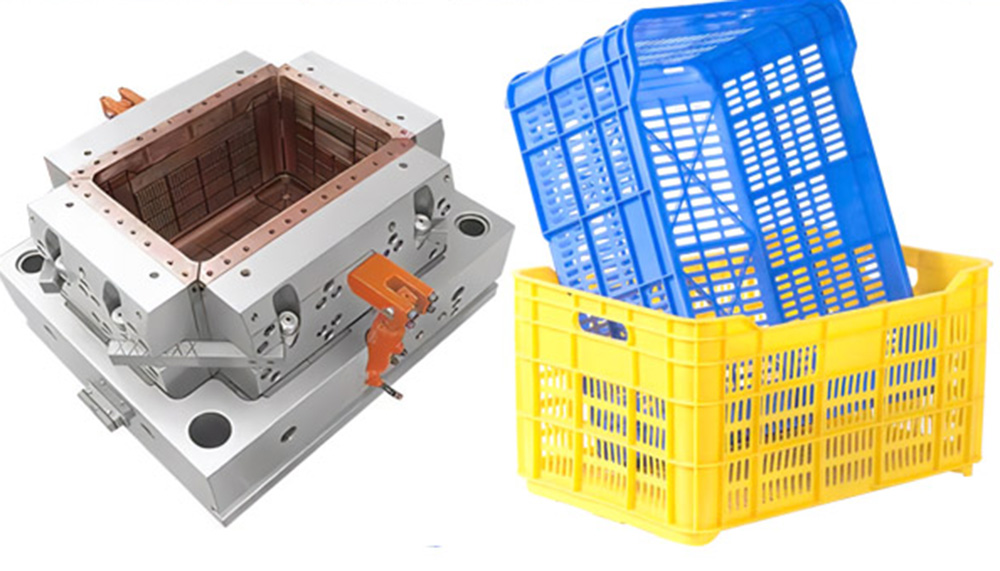
- Plastic Crate Molds: High-efficiency, rapid-cycle tools featuring optimized multi-stage venting paths and flash-free parting lines for industrial material handling containers.
- Plastic Chair Molds: Ergonomic, aesthetically flawless furniture molds incorporating gas-assisted injection channels to achieve superior structural strength and premium surface finishes.
Consult Our Tooling Engineering Desk
Are you evaluating a new automated logistics packaging line? Let our design office provide you with precise injection simulation reports, machinery compatibility sizing, and detailed investment return analysis. Contact ISMMOULD today to develop tooling optimized for maximum efficiency, speed, and durability.