Plastic Crate Mold Buying Checklist: 18 Questions Every Buyer Must Ask Before Ordering
A Professional Engineering Sourcing Guide by ISMMOULD — Industry Experts in Plastic Crate Molds, Pallet Molds, and Plastic Chair Molds
Executive Summary
Purchasing high-volume industrial tooling like plastic crate molds , pallet molds , or plastic chair molds represents a significant capital expenditure. A sub-par mold can lead to endless production downtime, excessive flash, warped products, and slow cycle times that drain your profitability. To safeguard your investment, ISMMOULD has compiled the ultimate 18-question checklist that procurement departments and injection molding engineers must evaluate before signing a mold manufacturing contract.
The 18-Question Procurement Matrix
This checklist is categorized into four critical engineering domains: Steel & Metallurgy, Cooling Optimization, Hot Runner Selection, and Production Durability.
| # | Crucial Engineering Question | Why It Matters & ISMMOULD Professional Benchmark |
|---|---|---|
| Category A: Tool Steel & Structural Integrity | ||
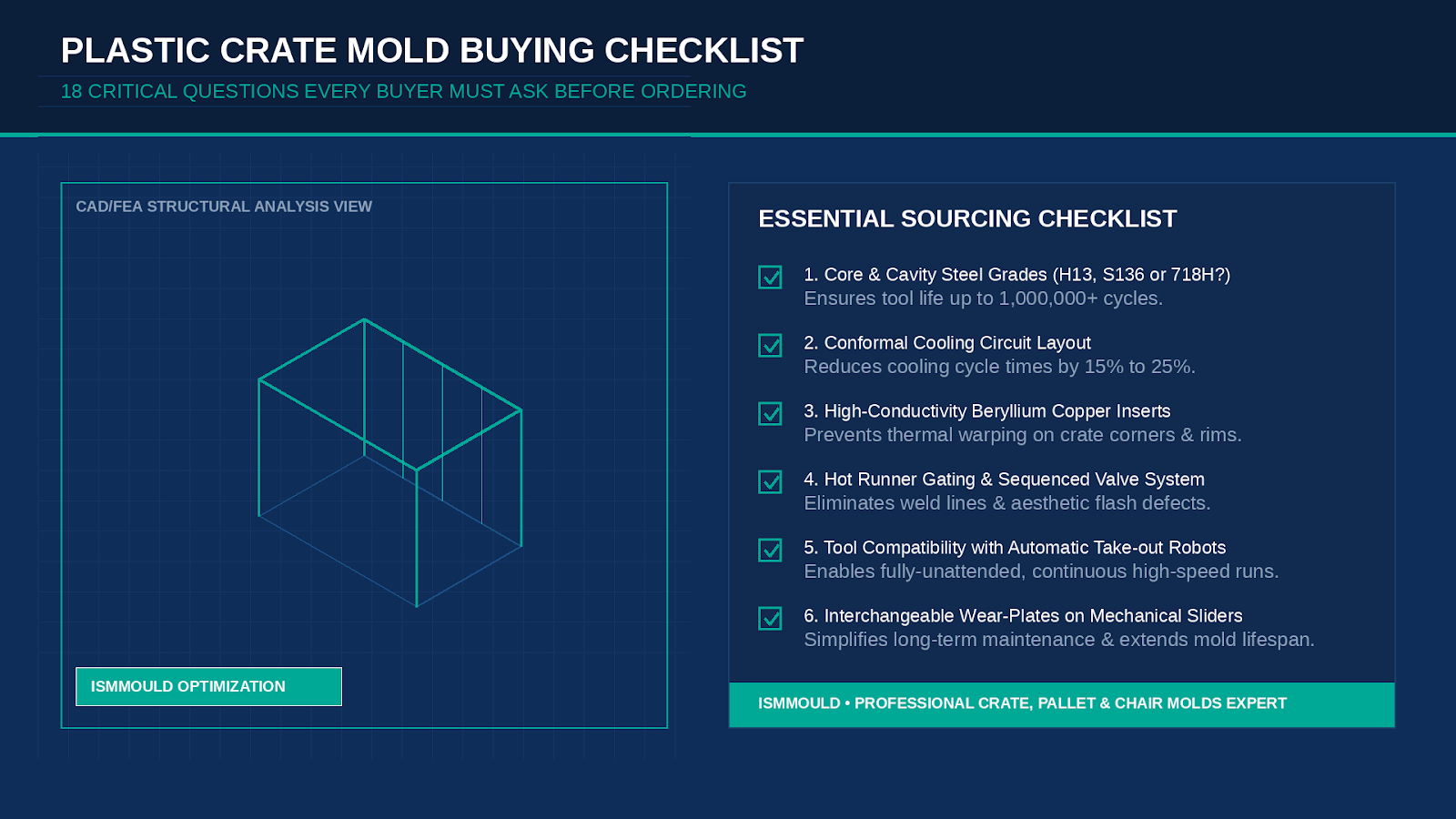
| 1 | What specific steel grade is used for the core and cavity? | Sourcing low-grade steel leads to premature mold wear. ISMMOULD recommends hardened H13, 718H, or S136 for logistics crate and chair molds to guarantee over 500,000 to 1,000,000 shots. |
| 2 | What is the Rockwell Hardness (HRC) of the treated steel? | Core and cavity must reach optimal hardness (typically 48-52 HRC for hardened steel) to resist injection abrasion from reinforced plastics or recycled materials. |
| 3 | Does the mold design incorporate interchangeable wear plates on sliders? | Heavy-duty crates and chairs require continuous slider movements. Interchangeable wear plates (made of self-lubricating bronze or hardened steel) prevent expensive core damage and simplify maintenance. |
| 4 | How is the mold base aligned and guided? | Large pallet and chair molds require high-precision guide pillars, wear strips, and heavy-duty locks to prevent mold shift under extreme clamping pressures. |
| 5 | Is the mold designed to handle recycled materials (rHDPE / rPP)? | Recycled resins often contain micro-impurities. ISMMOULD deploys specialized chrome plating or PVD surface treatments to protect the cavities from chemical corrosion and abrasion. |
| Category B: Thermal Management & Cycle Time Optimization | ||
| 6 | Is the mold engineered with conformal or double-loop cooling? | Cooling accounts for over 60% of the cycle time. Our crate molds utilize independent dual-circuit cooling loops that hug the part contour to drastically reduce cooling duration. |
| 7 | Are Beryllium Copper (BeCu) inserts integrated into high-heat zones? | Heat accumulates rapidly in deep corners, rib bases, and the rim of plastic chairs and crates. Placing BeCu inserts in these zones speeds up heat dissipation and eliminates warping. |
| 8 | What is the target cycle time guaranteed by the mold manufacturer? | A high-speed crate mold should achieve a cycle time of under 35-45 seconds. Confirming this beforehand prevents low production efficiency. |
| 9 | How are the cooling channels sealed to prevent leakage over time? | We use premium high-temperature viton O-rings and recess them deeply to avoid thermal expansion leaks during continuous operations. |
| Category C: Hot Runner & Melt Flow Dynamics | ||
| 10 | Which hot runner brand and gating type are specified? | Reliable gating is vital for structural stability. ISMMOULD utilizes globally supported hot runner systems (like YUDO, Synventive, or Husky) with sequential valve gating to ensure balanced cavity filling. |
| 11 | Has a comprehensive Moldflow Analysis been performed? | A rigorous moldflow simulation identifies weld lines, air traps, and shear heating beforehand, preventing physical weak points on pallet corners and crate handles. |
| 12 | Is the hot runner system easy to clean and maintain? | Using modular hot runner tips ensures that maintenance can be performed directly on the injection machine, minimizing expensive teardown hours. |
| 13 | What is the gating footprint left on the final product? | For aesthetic products like plastic monobloc chairs, gate locations must be carefully hidden underneath the seat while maintaining optimal melt distribution. |
| Category D: Ejection, Safety & Production Automation | ||
| 14 | What ejection mechanism is used (pins, stripper plates, or air ejectors)? | Thin-walled crates benefit from robust stripper plates combined with air assistance, ensuring fast and automatic part release without cracking the rims. |
| 15 | Does the mold include an automatic stroke safety sensor? | To protect the core-cavity during high-speed automated runs, limit switches and pressure sensors must verify full slider and ejector retraction before the mold closes. |
| 16 | Is the tooling compatible with robot take-out arms? | Modern manufacturing relies on automation. ISMMOULD configures all crate, pallet, and chair molds with standardized robot mounting coordinates and fast-release ejection designs. |
| 17 | How are venting channels designed to prevent burn marks? | We machine 0.015mm to 0.025mm micro-vents along the parting lines and core inserts, ensuring trapped air escapes smoothly during high-velocity injections. |
| 18 | What documentation and spare parts package are included upon delivery? | A professional factory must provide full 2D/3D design blueprints, moldflow reports, hot runner schematics, and a comprehensive kit of high-wear spare parts (O-rings, ejector pins, heating bands). |
Why ISMMOULD is the Premier Tooling Partner for Global Plastics Manufacturers
At ISMMOULD, we don't just build molds; we engineer production solutions. Over the past decades, our factory has perfected the art of high-speed, heavy-duty industrial injection molding. Whether you are seeking a multi-cavity stackable plastic crate mold , a robust 4-ton pallet mold , or an elegant gas-assisted plastic chair mold , our engineering team applies the highest standards of European tooling architecture to every project.
Our key advantages include:
- Optimized Wall-to-Rib Physics: Maximizing structural stacking weight and drop-resistance while reducing plastic part weight by up to 10-15%.
- Premium Thermal Management: Harnessing Beryllium Copper and optimized water line routes to squeeze out every possible second of cooling time.
- Turnkey Support: From conceptual CAD drawing optimization and moldflow simulation to final trail runs and global shipment setup.
Partner with ISMMOULD Today
Ready to upgrade your production capabilities? Get in touch with our design office. Our specialized engineers will guide you through our checklist to tailor-make the ultimate high-yield mold solution for your injection lines.