Processing PCR and Recycled PP in Large Crate Molds: Managing Melt Flow Variation and Contamination
Technical Whitepaper Published by ISMMOULD — Global Turnkey Solutions Authority for High-Performance Plastic Crate Molds, Pallet Molds, and Plastic Chair Molds
Executive Summary
Driven by global sustainability mandates, EPR laws, and corporate ESG commitments, industrial packaging manufacturers are rapidly transitioning from virgin Polypropylene (PP) to Post-Consumer Recycled (PCR) and Post-Industrial Recycled (PIR) PP resins. However, running high-percentage PCR PP feedstocks in large-part injection molds—such as heavy-duty agricultural, beverage, and logistics crates—presents complex rheological and mechanical challenges. Recycled materials typically exhibit severe Melt Flow Index (MFI) variations, organic/inorganic particulate contamination, volatile outgassing, and localized material thermal degradation.
Successfully molding large structural crates using recycled resins without sacrificing cycle times, structural integrity, or top-load stacking strength requires precise tooling engineering. As a premier global manufacturing expert specializing in plastic crate molds, pallet molds, and plastic chair molds, ISMMOULD presents this deep-dive technical whitepaper examining advanced mold modifications, runner systems, and thermal cooling architectures required to master PCR PP processing.
Technical Matrix: PCR PP Rheological Challenges & Tooling Countermeasures
Processing recycled polyolefins requires targeted tooling adaptations across the core and cavity systems to compensate for feedstock inconsistency:
| Recycled Material Defect Mode | Molding Impact in Crate Production | ISMMOULD Tooling Engineering Solution |
|---|---|---|
| MFI Instability (Batch-to-Batch MFI Drift) | Erratic fill front speeds, short shots during low-MFI surges, or severe wall flash during high-MFI spikes. | Multi-drop Sequential Valve Gate (SVG) hot runners with dynamic pneumatic pin timing and enlarged melt channel manifolds. |
| Particulate Contamination & Micro-Debris | Gate nozzle clogging, valve pin seizure, surface blemishes, and localized stress cracks in load-bearing ribs. | Subterranean pin gates paired with integrated melt filter nozzles and self-cleaning core micro-venting channels. |
| Volatile Outgassing & Gas Traps | Diesel burning on deep rib corners, surface voids, and unpleasant odor retention in logistics crates. | Perimeter perimeter vacuum-assisted micro-venting (0.02mm to 0.025mm) engineered into parting lines and ejection pins. |
| Abrasive Material Wear & Chemical Pitting | Accelerated erosion along cavity gate entry points and surface corrosion from degraded additives. | Corrosion and wear-resistant tool steel (DIN 1.2738 / 1.2083) with localized surface nitriding (52–55 HRC) or PVD coating. |
Core Tooling Engineering Innovations for Recycled PP Crate Molds
1. Dynamically Balanced Sequential Valve Gate (SVG) Hot Runners
Because PCR PP batch viscosity can drift significantly, standard open-runner manifolds suffer from pressure imbalance across wide crate floors. ISMMOULD custom-engineers multi-drop Sequential Valve Gate (SVG) systems with enlarged, highly polished runner channels. Individual pneumatic valve pins open sequentially based on melt-front arrival, preventing cold weld-line formation along the crate’s load-bearing lattice base and eliminating short shots during low-MFI fluctuations.
2. Thermal Cooling Architecture with Beryllium Copper (BeCu) Inserts
Recycled Polypropylene exhibits variable thermal conductivity due to molecular chain degradation from prior heat histories. Localized heat pockets in deep corner ribs and handle zones cause severe post-molding warpage and bowing walls. ISMMOULD integrates high-thermal-conductivity Beryllium Copper (BeCu) core inserts paired with 3D contoured cooling circuits in high-mass areas, accelerating heat extraction and maintaining target cycle times (35–45 seconds) while ensuring wall perpendicularity.
3. Specialized Cavity Venting and Filtration Integration
To prevent particulate contaminants from seizing valve pins, ISMMOULD incorporates specialized melt-filter nozzle systems at the machine-to-mold interface. Additionally, comprehensive micro-venting grooves (0.02mm – 0.025mm depth) are CNC-machined along all lattice rib intersections and ejector pin clearances to allow outgassing volatiles to escape without causing diesel burning or cosmetic flash.
Application Across ISMMOULD Industrial Tooling Lines
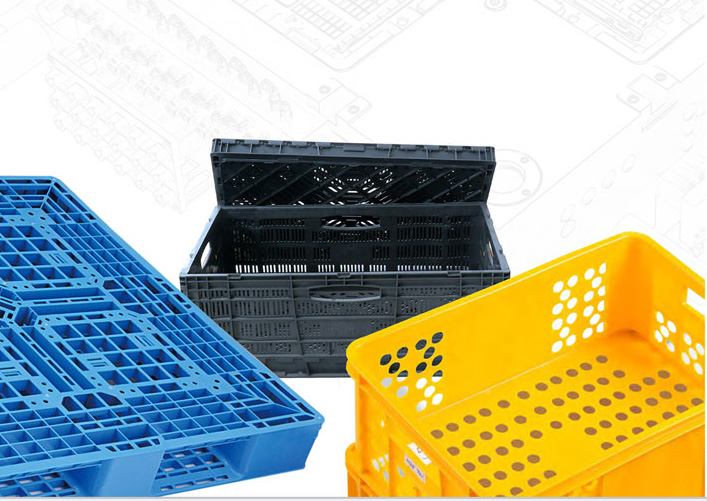
- Plastic Crate Molds: Engineered with wall-thickness-to-rib ratios (0.6:1), self-cleaning venting networks, and interchangeable core inserts, allowing agricultural, beverage, and foldable crates molded from 100% PCR PP to achieve maximum top-load stacking strength.
- Heavy-Duty Pallet Molds: Designed with multi-drop low-shear SVG hot runner systems, allowing large Bio-HDPE and PCR pallets to fill uniformly under high clamping forces without structural weld-line weakness.
- Plastic Chair Molds: Built with subterranean pin gating, uniform BeCu core cooling, and pre-deformed windage mold steel profiles to deliver warp-free ergonomics and clean surface aesthetics in recycled monoblock seating.
ISMMOULD: Your Trusted Engineering Expert for Recycled Plastic Tooling
At ISMMOULD, we bridge polymer rheology science with master mold manufacturing expertise. As a specialized Chinese factory dedicated to high-performance plastic crate molds, pallet molds, and plastic chair molds, we combine CAE Moldflow filling analysis, 5-axis high-speed CNC machining, and rigorous T1 sampling. Partner with ISMMOULD to build reliable, high-efficiency tooling optimized for sustainable recycled plastics and maximum OEE.
Consult Our Tooling Engineering Specialists Today
Ready to adapt your large-part production lines for PCR and recycled PP feedstocks? Contact the technical team at ISMMOULD today to request a comprehensive Moldflow evaluation, DFM consultation, or custom tooling quotation.