Processing PP vs HDPE in Crate Molds: Key Mold Design Differences You Need to Know
Technical Whitepaper Published by ISMMOULD — Global Turnkey Solutions Authority for High-Performance Plastic Crate Molds, Pallet Molds, and Plastic Chair Molds
Executive Summary
In high-tonnage industrial container manufacturing, selecting between Polypropylene (PP) and High-Density Polyethylene (HDPE) dictates not only the final performance of the crate—such as impact strength at freezing temperatures or top-load stacking rigidity—but also fundamental tooling architecture. Due to distinct crystallization rates, volumetric thermal shrinkage ratios, melt flow behaviors, and mechanical stress profiles, a single crate mold layout cannot perform optimally for both polymers without targeted engineering adjustments.
As a leading global manufacturing specialist in plastic crate molds, pallet molds, and plastic chair molds, the engineering division at ISMMOULD delivers this technical comparative analysis. We break down the precise mold design modifications required—from shrinkage compensation to gating, venting, and ejection dynamics—when optimizing tooling for PP versus HDPE processing.
1. Polymer Thermodynamics & Shrinkage Profiles
Both PP and HDPE are semi-crystalline polyolefins, yet their molecular chain behavior during phase change creates vastly different tooling requirements:
- Volumetric Shrinkage Variances: HDPE exhibits a significantly higher and more anisotropic volumetric shrinkage rate (typically **1.5% to 3.0%**) compared to PP (typically **1.0% to 2.0%**). Tooling engineered for HDPE must incorporate larger steel dimensions in cavity cores to prevent undersized finished containers.
- Thermal Conductivity & Cooling Cycles: HDPE possesses higher thermal conductivity than PP, allowing faster heat dissipation if cooling channels are positioned correctly. However, HDPE's higher crystallization energy requires precise thermal control to prevent non-uniform shrinkage and post-ejection bow.
- Cold Temperature Impact Resistance: HDPE maintains high impact strength below 0°C, making it the preferred resin for cold-chain agricultural and seafood crates. PP provides superior flexural modulus and hinge fatigue resistance, ideal for room-temperature logistics and foldable crates.
2. Technical Matrix: PP vs. HDPE Mold Design Parameters
Optimizing plastic crate tooling for PP versus HDPE requires targeted structural modifications across all primary tool systems:
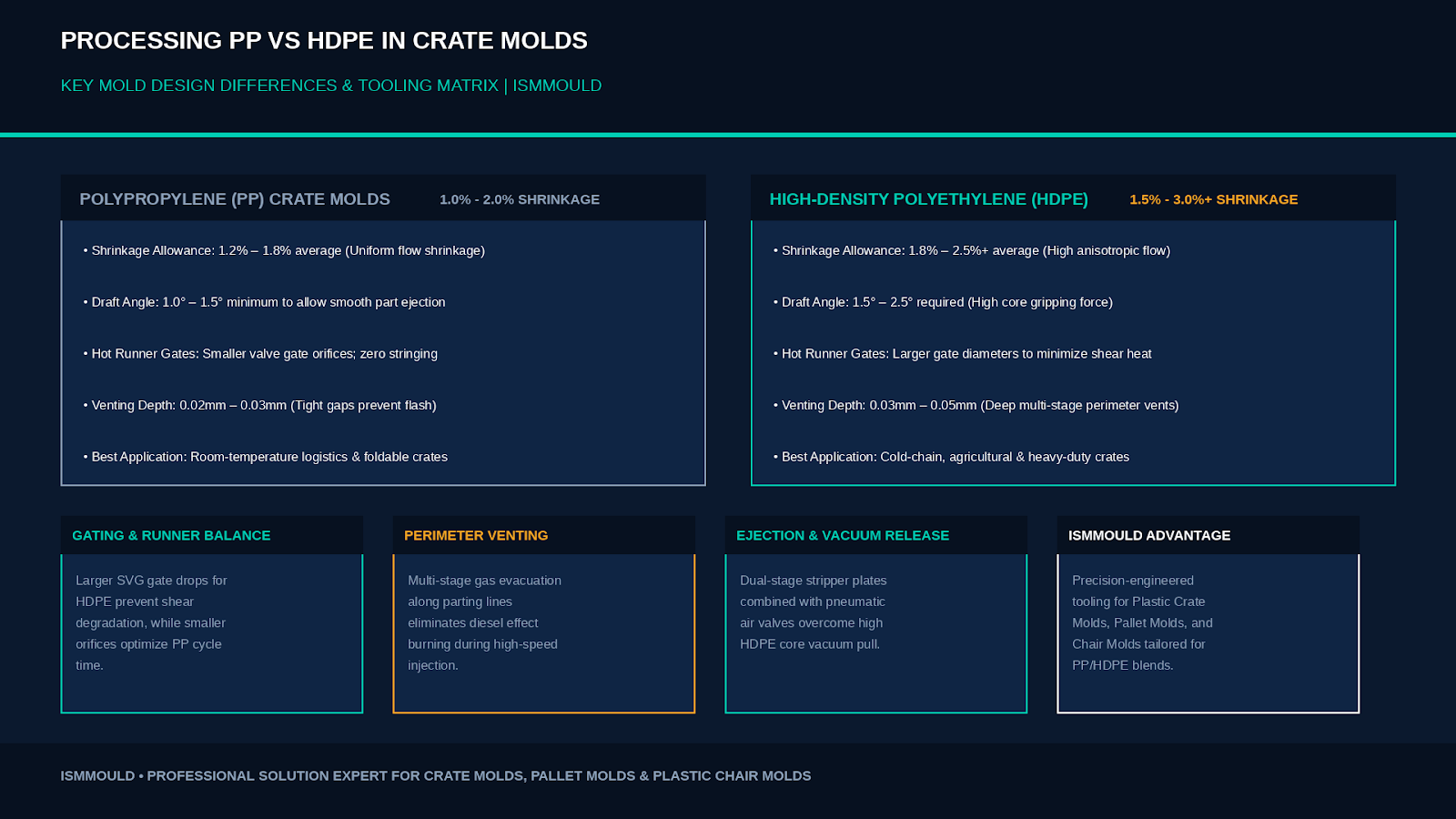
| Tooling Design Vector | Polypropylene (PP) Crate Molds | High-Density Polyethylene (HDPE) Crate Molds |
|---|---|---|
| Steel Shrinkage Allowance | 1.2% – 1.8% average (More uniform across flow direction). | 1.8% – 2.5%+ average (High differential shrinkage parallel vs. perpendicular to flow). |
| Draft Angle Requirements | 1.0° – 1.5° minimum to prevent wall scuffing during ejection. | 1.5° – 2.5° required due to higher material grip on core blocks during cooling. |
| Hot Runner Gate Sizing | Smaller valve gate tips; lower tendency to string or drool. | Larger gate diameters required to avoid shear degradation and ensure adequate pack/hold pressure. |
| Venting Depth Tolerances | 0.02mm to 0.03mm (Lower viscosity requires tight gaps to avoid flash). | 0.03mm to 0.05mm (Higher melt viscosity allows deeper vents without flashing). |
| Ejection Force & Area | Standard ejector pin grids and stripper plates. | Reinforced stripper plates & air ejection valves required to overcome high core vacuum pull. |
3. Deep-Dive: Core Tooling Engineering Adjustments
A. Gating System & Runner Balance
Because HDPE exhibits high melt viscosity under high shear rates, ISMMOULD engineers larger drop gate channels with sequential valve gating (SVG) for HDPE crate tools. This ensures uniform mold cavity filling without creating extreme pressure drops. For PP crate molds, smaller gate orifices prevent gate vestige protrusion while optimizing cycle times.
B. Advanced Venting Layouts along Parting Lines
Adequate venting is essential for fast-cycling crate production. Because HDPE processing involves higher injection speeds to fill thin-walled lattice ribs, air entrapment can lead to diesel effect burning. ISMMOULD integrates multi-stage perimeter gas vents with vacuum assistance, ensuring complete evacuation of trapped air at deep corner intersections.
C. Ejection Mechanism Optimization
HDPE shrinks tightly onto mold core blocks during the cooling phase. Without balanced ejection, stripper plates can cause stress whitening or bottom grid bowing. ISMMOULD incorporates **dual-stage ejection mechanisms** combining mechanical stripper plates, pneumatic core valves, and wear-resistant guide pillars to ensure fast, automated part ejection without deformation.
4. ISMMOULD: Professional Crate, Pallet & Chair Mold Expert
Whether processing PP, HDPE, or recycled polyolefin blends, ISMMOULD provides custom-engineered tooling solutions optimized for high-speed automated production lines:
- Plastic Crate Molds: Precision single and multi-cavity container molds designed for agricultural packaging, bottle crates, folding boxes, and industrial logistics containers.
- Pallet Molds: High-tonnage, heavy-duty pallet tooling equipped with multi-drop hot runners, BeCu thermal inserts, and conformal cooling circuits for maximum load capacity.
- Plastic Chair Molds: Ergonomic monoblock, gas-assisted, and stackable seating molds crafted for surface clarity, structural strength, and zero warp deflection.
Consult Our Tooling Engineering Team
Selecting the right resin and matching mold architecture is critical to maximizing OEE and reducing unit production costs. Partner with ISMMOULD for complete Moldflow resin simulation, mold engineering consultations, and custom tooling quotes. Contact our technical sales team today to optimize your next crate manufacturing project.