Why Conformal Cooling Matters in Large Crate and Pallet Molds for Cycle Time Reduction
Technical Whitepaper Published by ISMMOULD — Global Turnkey Solutions Authority for High-Performance Pallet Molds, Plastic Crate Molds, and Plastic Chair Molds
Executive Summary
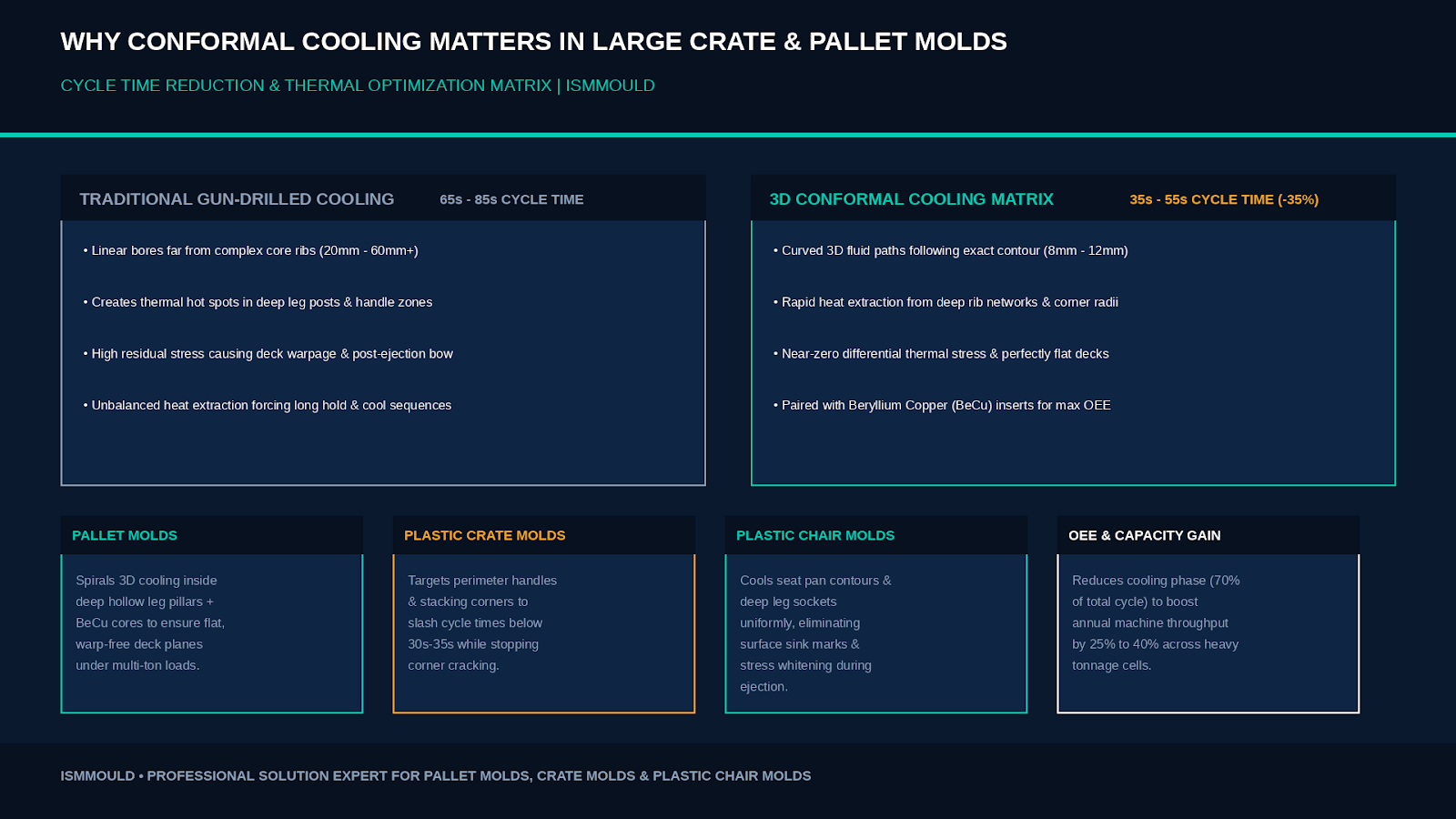
In high-tonnage industrial injection molding, cooling accounts for up to **60% to 70% of the total injection cycle time**. For massive structural parts—such as heavy-duty logistics pallets, multi-use agricultural crates, and commercial monoblock chairs—thermal efficiency directly dictates operational throughput and unit production economics. Traditional straight-drilled cooling lines struggle to dissipate heat evenly from deep rib geometries, thick core posts, and complex corner intersections. This results in severe thermal hot spots, extended cooling delays, and post-ejection warpage.
Implementing **3D Conformal Cooling Technology** revolutionizes heat transfer by mapping fluid channels to follow the exact three-dimensional contours of the mold cavity and core. As an industry-leading manufacturing specialist in pallet molds, plastic crate molds, and plastic chair molds, the engineering matrix division at ISMMOULD presents this technical analysis detailing how conformal thermal management slashes cycle times, mitigates part deformation, and maximizes Overall Equipment Effectiveness (OEE).
1. The Thermodynamics of Large-Part Injection Molding
When processing High-Density Polyethylene (HDPE) or Polypropylene (PP) into heavy structural components, huge volumes of thermal energy must be evacuated rapidly. Standard gun-drilling methods impose severe geometric limitations on cooling channel placement:
- The Distance Delta: Straight-drilled lines remain far away from complex internal features, such as the deep hollow legs of pallets or the reinforced grid intersections of returnable crates. Heat gets trapped in these core pockets, creating thermal dead zones.
- Differential Shrinkage and Warpage: When part perimeters cool significantly faster than dense central rib intersections, high internal residual stresses develop. Upon ejection, this temperature gradient induces bowing, deck deflection, and dimensional instability.
- Extended Hold & Cool Sequences: Operators are forced to extend the cooling phase simply to allow inner core hot spots to solidify sufficiently for ejection without ejector pin push-through or stress whitening.
2. Technical Matrix: Traditional Gun-Drilled vs. Conformal Cooling Systems
Evaluating the transition from conventional cooling circuits to advanced conformal cooling networks reveals substantial performance gains across key operational vectors:
| Thermal Design Parameter | Traditional Gun-Drilled Cooling Circuits | 3D Conformal Cooling Matrix (ISMMOULD) |
|---|---|---|
| Channel Geometry & Proximity | Linear, rigid intersecting bores. Variable distance (20mm to 60mm+) from complex part contours. | Curved 3D fluid paths maintaining a constant, optimized distance (typically 8mm to 12mm) from all part surfaces. |
| Heat Dissipation Uniformity | Uneven thermal gradient. Core pockets retain heat, causing localized hot spots. | Uniform heat extraction across variable wall thicknesses, deep rib networks, and corner radii. |
| Cycle Time Impact | Baseline cycle times (e.g., 65s–85s for heavy pallets; 35s–50s for large crates). | Dramatically reduced cycle times (typically 15% to 35% faster, dropping pallet cycles below 55s). |
| Part Deflection & Quality | Higher risk of warpage, sink marks on thick rib junctions, and internal voids. | Near-zero differential stress, flat deck planes, eliminated sink marks, and strict dimensional tolerances. |
3. Product-Specific Optimization: Crates, Pallets, and Chairs
At ISMMOULD, conformal cooling topology is tailored specifically to the structural demands of each major industrial product line:
A. Pallet Molds: Cooling Deep Leg Posts and Heavy Load Grids
Heavy-duty rackable pallets rely on massive hollow leg pillars to absorb dynamic forklift impacts. Conventional cooling cannot easily access the tips of these deep steel cores. ISMMOULD combines 3D metal additive manufacturing (SLM) conformal inserts with high-conductivity **Beryllium Copper (BeCu)** cores in these leg zones. Water spirals directly inside the core skin, pulling heat away in seconds and ensuring flat, warp-free deck planes capable of supporting multi-ton rack loads.
B. Plastic Crate Molds: High-Speed Cycle Maximization
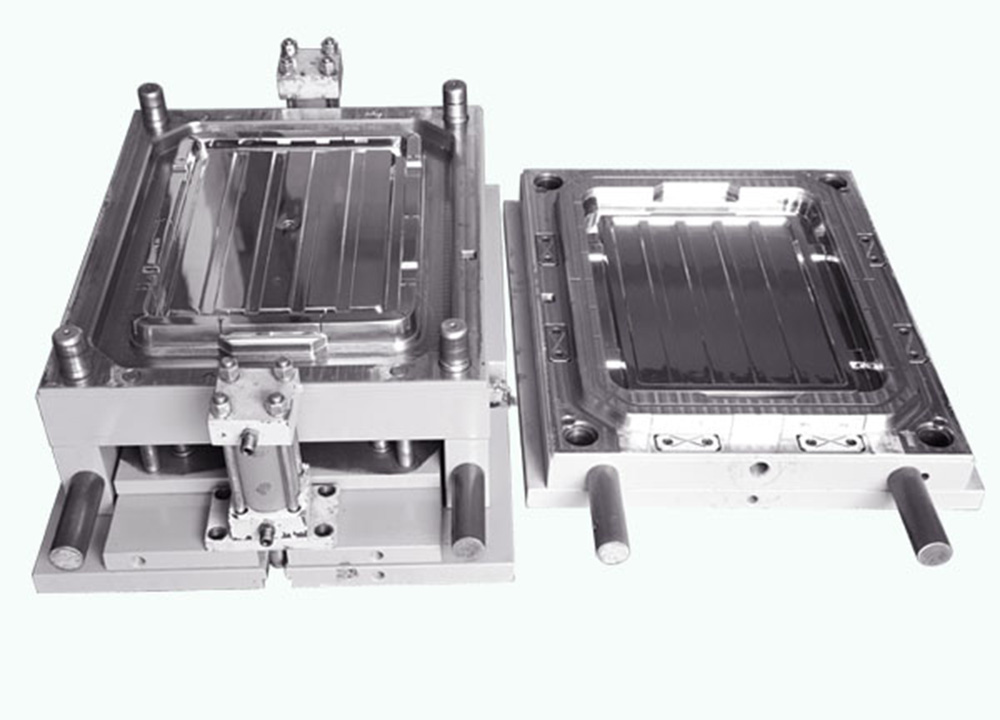
High-volume logistics and agricultural crates operate on narrow margin curves where seconds matter. The primary cooling bottlenecks occur at the top rim handles, stacking corners, and base rib intersections. Integrating conformal cooling loops around the perimeter handle cutouts and corner locks allows **plastic crate molds** to achieve rapid, flash-free cycle speeds under 30–35 seconds while preventing corner cracking during high-density stacking.
C. Plastic Chair Molds: Flawless Surface Aesthetics & Leg Integrity
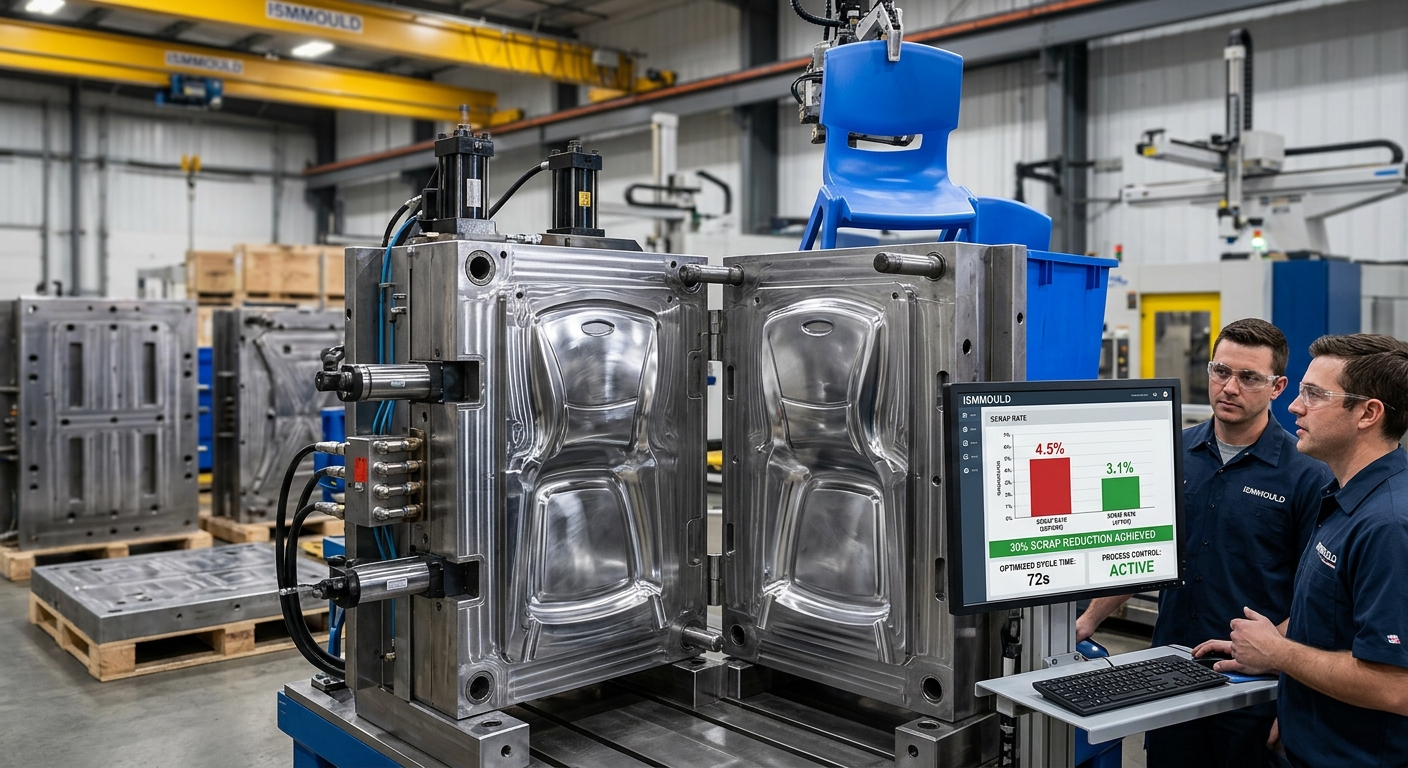
Commercial monoblock and gas-assisted chairs require pristine aesthetic surfaces combined with high structural strength. Heat accumulation in thick armrests or chair leg sockets causes surface sink marks and gloss variations. Conformal cooling channels beneath the seat pan and down the leg cores ensure balanced heat dissipation, eliminating surface sink marks and stress whitening during ejection.
4. ISMMOULD: Your Turnkey Industrial Tooling Authority
Integrating conformal cooling into massive steel tooling blocks requires sophisticated thermal simulation, advanced powder metallurgy, and precise multi-axis CNC finishing. ISMMOULD brings end-to-end engineering excellence to every project:
- Pallet Molds: Engineered single and multi-cavity tools built with hardened alloy steel blocks (718H, H13), multi-drop hot runners, and conformal thermal management for maximum load durability.
- Plastic Crate Molds: High-efficiency, rapid-cycling container molds featuring advanced multi-stage venting, hardened parting lines, and automated stripper plates for continuous operation.
- Plastic Chair Molds: Precision-crafted monoblock and gas-assisted seating molds engineered for ergonomic comfort, high weight capacity, and mirror-polished surface aesthetics.
Consult Our Thermal Engineering Desk
Is your plant seeking to reduce cycle times, resolve persistent part warpage, or boost the OEE of existing high-tonnage machine cells? Let ISMMOULD provide a comprehensive Moldflow thermal simulation, conformal cooling design review, and turnkey tooling proposal. Contact our engineering office today to unlock unprecedented production efficiency.