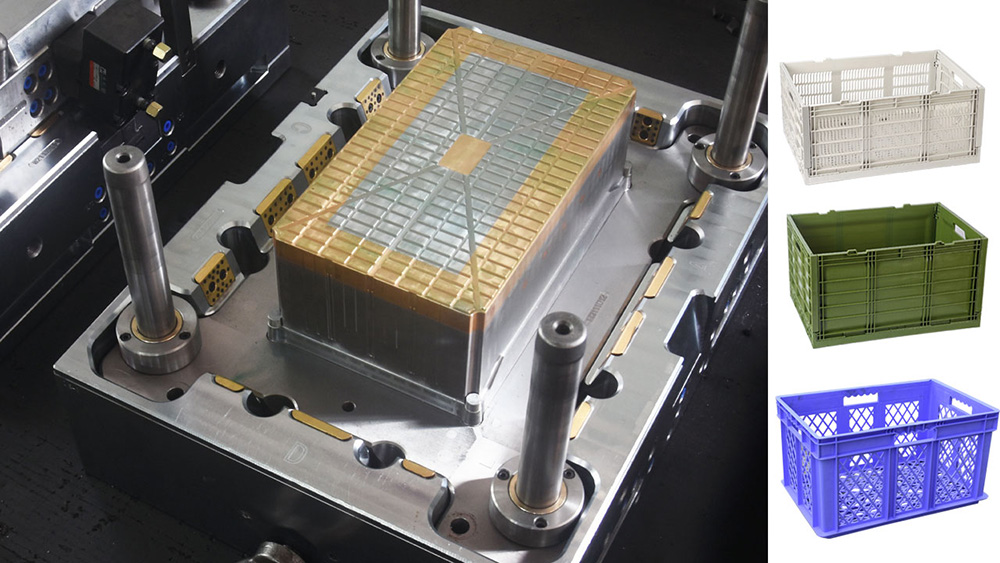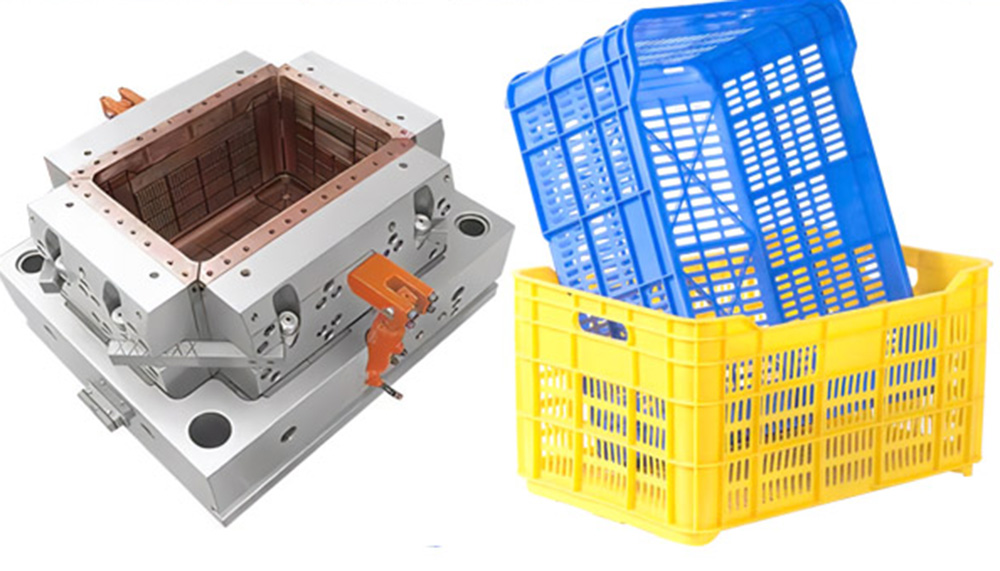

Designing molds for large logistics containers—such as 1200×1000mm pallet crates or 800×600mm Euro totes—presents a key challenge: balancing warpage and shrinkage. Uneven shrinkage leads to warpage, which causes stacking failures and handling issues. At ISM, we have a proven approach to solve both problems together.
1. Understanding the Problem
| Issue | Cause | Effect |
|---|---|---|
| Shrinkage | Plastic cools from melt to room temperature | Parts smaller than cavity |
| Differential shrinkage | Uneven cooling or filling | Warpage (bowing, twisting) |
| Anisotropic shrinkage | Shrinkage differs by flow direction | Parts out of square |
Key insight: Control differential shrinkage = control warpage.
2. ISM's Four-Step Approach
Step 1: Material Characterization
Different materials shrink differently. ISM starts with accurate material data.
| Material | Shrinkage Range | Anisotropy Risk |
|---|---|---|
| Copolymer PP | 1.0–1.8% | Low (preferred) |
| HDPE | 1.5–2.5% | High |
| PP + Talc | 0.8–1.2% | Very low |
Step 2: Gate & Runner Balance
Uneven filling creates uneven shrinkage.
| Container Size | Gate Recommendation |
|---|---|
| < 600mm | 2-point edge gate |
| 600–1200mm | 4-point hot runner |
| > 1200mm | 6–8 point sequential valve gate |
Step 3: Cooling System Design – Most Critical Factor
Non-uniform cooling is the #1 cause of warpage.
| Cooling Type | Temperature Uniformity | Warpage Reduction |
|---|---|---|
| Straight-drilled | Poor (±15–20°C) | Baseline |
| Conformal (milled) | Good (±5–8°C) | 40–60% |
| Conformal (3D printed) | Excellent (±3–5°C) | 50–70% |
ISM standard: Conformal cooling + zone temperature control for all large container molds.
Step 4: Shrinkage Compensation
ISM applies anisotropic compensation—different factors for flow vs. cross-flow directions.
| Direction | Typical PP Shrinkage | Cavity Adjustment |
|---|---|---|
| Flow direction | 1.2–1.5% | +1.35% |
| Cross-flow | 1.5–1.8% | +1.65% |
Ignoring this makes square parts rectangular.
3. Advanced Technique: Pre-Cambering
For predictable warpage, ISM machines reverse curvature into the cavity.
| Warpage Type | Cavity Pre-Camber | Result |
|---|---|---|
| Base bows up | Convex cavity | Flat base |
| Base bows down | Concave cavity | Flat base |
Typical pre-camber: 0.5–2.0mm over 1000mm.
4. Case Study: 1200×1000mm Pallet Crate
| Metric | Before (Conventional) | After (ISM Design) |
|---|---|---|
| Gate | Single edge | 6-point sequential |
| Cooling | Straight-drilled | Conformal + 4 zones |
| Shrinkage comp. | Isotropic (1.5%) | Anisotropic (1.35/1.65%) |
| Warpage (length) | 5.8 mm | 1.9 mm |
| Warpage (width) | 4.2 mm | 1.4 mm |
| Cycle time | 85 sec | 52 sec |
Result: Warpage reduced by 67%, cycle time improved by 39%.
5. Quick Checklist for Buyers
When sourcing a large logistics container mold, ask your supplier:
Do you use anisotropic shrinkage compensation?
Is cooling conformal or straight-drilled?
How many gate points do you recommend for my part size?
Do you simulate warpage before cutting steel?
Will you use pre-cambering if needed?
ISM answers "yes" to all five.